

Benefits of Sandalwood in Uttarakhand: How One Tree Can Support Nature, Communities and Sustainable Livelihoods

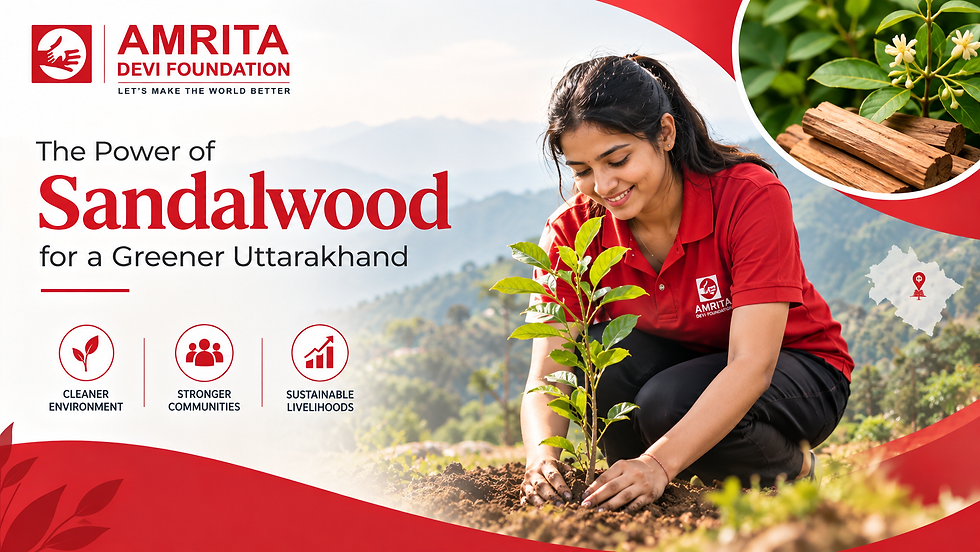
What if planting one saanting one sapling could become part of a much longer journey involving environmental restoration, community participation, rural livelihoods and responsible CSR?
This is the larger story behind sandalwood plantation in Uttarakhand.
Indian sandalwood, scientifically known as Santalum album, has been valued in India for centuries because of its aromatic heartwood, oil, cultural importance and commercial applications. Scientific literature identifies sandalwood as a commercially and culturally important species, with its heartwood and oil used in areas including perfumes, cosmetics, soaps, carving and traditional practices.
But there is another side to the story.
Sandalwood is not simply a valuable tree. It is a long-term ecological and community project.
And in the hills of Uttarakhand, that distinction matters.
Why Is Sandalwood Important for Uttarakhand?
Uttarakhand is already a forest-rich Himalayan state. The Forest Survey of India's India State of Forest Report 2023 records about 24,304 km² of forest cover within Uttarakhand's division boundaries, representing about 45.33% of the digitized division-boundary area used in its assessment.
So the objective should not be to suggest that Uttarakhand simply needs "more trees."
The real environmental question is more nuanced:
How can tree-based initiatives complement existing ecosystems while also creating sustainable opportunities for rural communities?
That is where carefully planned sandalwood plantation can become relevant.
Sandalwood can be incorporated into broader agroforestry and plantation models, provided the species, host plants, site conditions and long-term management are appropriate.
Recent scientific research highlights that compatible host species are particularly important for successful sandalwood cultivation.
This means sandalwood plantation is not about simply putting a sapling into the ground.
It is about creating the conditions for that sapling to survive.
What Is Indian Sandalwood?
Indian sandalwood, Santalum album, is a small-to-medium-sized tree known especially for its aromatic heartwood.
Its value comes largely from the heartwood and the oil obtained from it.
The characteristic fragrance is associated with compounds such as α- and β-santalol, which contribute to sandalwood oil's commercial importance. Research describes applications across perfumes, cosmetics, soaps, toiletries, carving and other traditional and industrial uses.
But here's something many people don't know:
Sandalwood is a hemi-parasitic tree.
It develops specialised root connections called haustoria through which it can obtain water and nutrients from suitable host plants.
In simple words:
Sandalwood doesn't grow completely alone.
It interacts with other plants.
Research has demonstrated the importance of host relationships for sandalwood establishment and growth, making host selection an important consideration in plantation planning.
That single fact changes how we should think about sandalwood plantation.
7 Benefits of Sandalwood Plantation in Uttarakhand
1. It Can Add Long-Term Value to Tree-Based Landscapes
Planting economically valuable trees can become part of a long-term land-use strategy.
Sandalwood's commercial value comes primarily from its heartwood and aromatic oil, which have established uses in several industries.
For rural communities, this creates the possibility of combining:
Environmental activity + long-term economic value.
However, sandalwood should not be presented as a quick-return crop.
Heartwood formation and oil accumulation take time, and research shows considerable variation depending on tree age, genetics, site and other factors. One recent review notes that heartwood formation commonly begins around the seventh year, while economically significant heartwood development can take considerably longer.
Therefore, sandalwood should be viewed as a long-term plantation investment, not an immediate-income solution.
2. Sandalwood Can Support Sustainable Livelihood Thinking
One of the most interesting aspects of sandalwood plantation in Uttarakhand is its potential connection with rural livelihoods.
Many hill communities face challenges associated with:
Limited agricultural land
Difficult terrain
Migration
Changing agricultural economics
Human-wildlife conflict
Rising cultivation costs
Limited local employment opportunities
ADF's own documented afforestation projects were designed around this broader challenge.
In its Ghughuti, Almora project, Amrita Devi Foundation worked with local communities on plantation of sandalwood and supporting species on private land that was described as underused because of migration and crop damage from wild animals. The project also created paid maintenance work for selected community members.
This illustrates an important principle:
A plantation can create value not only through the tree, but through the people involved in caring for it.
3. Sandalwood Encourages Agroforestry Thinking
Because sandalwood is hemi-parasitic, its cultivation requires consideration of host plants.
This makes sandalwood particularly interesting from an agroforestry perspective.
A scientific plantation model can consider:
Sandalwood + compatible host plants + suitable site + maintenance + monitoring
rather than treating sandalwood as an isolated crop.
A 2024 scientific review specifically identifies compatible host selection as crucial for successful sandalwood plantations and highlights sandalwood-based agroforestry as a potential way to meet demand while supporting farmer income.
Research has also demonstrated nutrient transfer relationships between sandalwood and certain host plants, further illustrating the ecological complexity of the system.
4. It Can Contribute to Long-Term Environmental Restoration
Trees can contribute to carbon storage, soil protection and broader ecological functions.
But responsible environmental communication needs an important distinction:
Plantation is not the same thing as natural forest.
A plantation cannot automatically replace a natural forest ecosystem.
Instead, plantation initiatives can complement broader environmental restoration when they are appropriately planned, monitored and maintained.
The Forest Survey of India monitors forest cover, tree cover, growing stock and carbon stock through its biennial India State of Forest Report.
For organisations working on plantation, the emphasis should therefore be on:
Survival, ecological suitability and long-term maintenance—not just planting numbers.
5. Sandalwood Has Cultural and Economic Importance
Sandalwood has deep cultural significance in India.
Its fragrance has been associated with religious practices, traditional ceremonies, art and craftsmanship for centuries.
Its commercial applications extend to:
Perfumes
Attars
Cosmetics
Soaps
Aromatic products
Carving
Traditional practices
Scientific literature describes Indian sandalwood as one of the world's commercially significant sandalwood species because of its valued heartwood and oil.
This combination of cultural value + commercial demand + ecological relevance makes sandalwood an interesting species for carefully managed long-term plantation projects.
6. Plantation Can Create Local Employment Around Tree Care
One aspect of afforestation that is often overlooked is the work required after planting.
Someone needs to:
Monitor saplings
Manage supporting vegetation
Check plant health
Maintain irrigation where necessary
Protect plants
Identify pest or disease problems
Replace failed saplings
Record survival
Maintain the plantation
ADF's documented Ghughuti project specifically describes employment created for local people involved in caring for planted trees.
This is where environmental work and social impact can intersect.
The tree grows.The community participates.The project creates local responsibility.
7. It Can Become a Long-Term Community Legacy
A plantation event lasts a few hours.
A tree can remain for decades.
That's why the real measure of environmental CSR shouldn't simply be:
"How many trees did we plant?"
It should also ask:
How many survived?
Who is maintaining them?
What happened after one year?
What happened after three years?
Are local communities involved?
Are host plants thriving?
Are failed saplings being replaced?
What environmental and social outcomes are being documented?
This shift from plantation activity to plantation impact is central to meaningful environmental CSR.
The Hidden Science Behind Sandalwood
Here's a fact worth understanding before anyone talks about sandalwood cultivation.
Sandalwood needs host plants.
Because Santalum album is a root hemi-parasite, it forms haustorial connections with other plants.
Studies have shown that the presence and identity of host plants can influence sandalwood survival and growth. A 2025 study comparing host relationships found that host presence significantly improved early survival, while different host species produced different growth responses.
This means that successful sandalwood plantation requires more than good intentions.
It requires:
Planning.
Scientific knowledge.
Suitable planting material.
Compatible hosts.
Maintenance.
Monitoring.
That is why responsible plantation projects work with ecological and agricultural considerations rather than simply focusing on the number of saplings planted.
Is Sandalwood Cultivation Easy?
No.
And this is something every responsible environmental organisation should communicate honestly.
Scientific literature identifies several challenges associated with sandalwood cultivation, including:
Host-plant compatibility
Quality planting material
Pests and diseases
Climate stresses
Grazing
Fire
Illegal harvesting
Regulatory considerations
Long time horizons
A recent scientific review notes that sandalwood faces threats including illegal harvesting, grazing, natural fires, disease and climate change.
The Indian Wood Science and Technology material also highlights the importance of quality planting material and the specific nursery requirements of sandalwood because of its hemi-parasitic nature.
So the right message is not:
"Plant sandalwood and become rich."
The responsible message is:
"Sandalwood is a long-term ecological and economic resource that requires scientific cultivation and sustained care."
Amrita Devi Foundation's Sandalwood Plantation Work in Uttarakhand
This is where the story becomes real.
Through Amrita Devi Earth Care, Amrita Devi Foundation works on environmental initiatives including afforestation and plantation, with a particular focus on sandalwood and economically beneficial tree species.
ADF says its plantation initiative involves local women, farmers and youth in planting, maintenance and protection, with the broader objective of connecting environmental sustainability with community participation and livelihood opportunities.
The Foundation currently reports 1,000+ sandalwood plants in Uttarakhand as part of its Earth Care work.
But the story didn't start with 1,000 trees.
It started with individual plantation sites.
From Ghughuti Village to a Bigger Vision
One documented ADF project took place in Ghughuti village, Almora, Uttarakhand.
In its 2024–25 project report, ADF documented the planting of 150 sandalwood plants and 50 host plants, following an earlier project involving 300 sandalwood and 100 host plants. The project included site assessment, community consultation, maintenance and monitoring.
ADF also documented an earlier 2023–24 project at Ghughuti involving 300 sandalwood plants and 100 host plants, supported by Experis IT.
This demonstrates a critical part of the model:
Plantation is being treated as a continuing project, not a one-day event.
When Industry Leaders Return to See the Trees
One of the most powerful parts of ADF's Earth Care story is what happened after the initial plantation.
Industry leaders and social-impact participants returned to Uttarakhand and revisited sandalwood plantation sites to see how the trees had developed.
ADF's website documents a recent social-work visit in which HR leaders and changemakers visited previously planted sandalwood sites and observed their growth. The Foundation describes the visit as part of its ongoing environmental and community-development work.
ADF's LinkedIn communication also describes the visit as a Social Work Vacation, where participants returned to the plantation site and planted additional sandalwood saplings while observing the progress of earlier plantings.
That creates a very different CSR narrative.
Plant.
Return.
Observe.
Protect.
Nurture.
Continue.
This is what long-term environmental responsibility can look like.
A Vision for a "Chandan State"
Amrita Devi Foundation has articulated a vision of making Uttarakhand a "Chandan State", with sandalwood plantation forming part of its environmental and livelihood-oriented work. ADF's recent communication connects this vision with long-term care, community participation and environmental sustainability.
The idea is not simply about increasing the number of sandalwood trees.
It is about creating a model where:
Trees → Communities → Livelihoods → Environmental Responsibility
work together.
And that requires patience.
Why Corporate Leaders Should Look Beyond One-Day Tree Plantation
For CSR leaders, the sandalwood story offers an important lesson.
A typical plantation campaign might look like:
Corporate team → plantation event → photographs → social media post → project completed
But environmental impact rarely works that way.
A stronger model looks like:
CSR partnership
↓
Site assessment
↓
Scientific plantation
↓
Community involvement
↓
Maintenance
↓
Monitoring
↓
Survival tracking
↓
Long-term reporting
ADF's own plantation documentation describes baseline assessment, site identification, consultant/project coordination, species selection and subsequent maintenance and monitoring.
That is the difference between planting trees and building an environmental program.
How Can Companies Support Sandalwood Plantation in Uttarakhand?
Companies interested in environmental CSR can consider supporting:
1. Plantation
Fund saplings and scientifically planned plantation activities.
2. Community Participation
Support local people who participate in planting and maintenance.
3. Monitoring
Track plantation survival and growth over time.
4. Environmental Education
Help communities understand the ecological and economic value of appropriate tree species.
5. Long-Term Maintenance
Allocate resources beyond the plantation day.
6. Impact Reporting
Measure outcomes rather than only counting activities.
This creates a more meaningful CSR journey:
Funding → Plantation → Community → Maintenance → Monitoring → Impact
Sandalwood and the Future of Rural Uttarakhand
The future of Uttarakhand's rural communities cannot depend on a single crop or a single tree species.
Sandalwood should therefore be understood as one component of a broader sustainable-landscape and livelihood strategy.
That strategy can include:
Agroforestry
Native species
Fruit-bearing trees
Soil conservation
Water management
Women's economic participation
Youth engagement
Skill development
Responsible tourism
Environmental education
The goal is not to replace Uttarakhand's natural ecosystems with sandalwood plantations.
The goal is to explore how carefully planned tree-based initiatives can complement ecological conservation while creating opportunities for communities.
The Bigger Lesson: A Tree Is a Long-Term Commitment
Anyone can plant a tree.
The harder part is coming back.
Coming back to water it.
Coming back to monitor it.
Coming back after one year.
Coming back after three years.
Coming back when something goes wrong.
And coming back with the community that helped plant it.
That is why the sandalwood plantation journey of Amrita Devi Foundation Earth Care is about more than trees.
It is about continuity.
It is about connecting corporate leaders, communities, environmental responsibility and long-term impact.
And ultimately, it is about asking a simple question:
What will we leave growing behind us?
Conclusion: The Value of Sandalwood Goes Beyond the Tree
The benefits of sandalwood in Uttarakhand go far beyond its fragrance or commercial value.
Indian sandalwood can contribute to carefully planned agroforestry systems, has important cultural and industrial uses, and can create long-term livelihood possibilities. At the same time, successful cultivation requires suitable hosts, scientific planning, maintenance, protection and patience.
For Uttarakhand, the opportunity lies in connecting environmental initiatives with the people who live alongside them.
For CSR leaders, the lesson is equally important:
Don't just plant a tree. Build a system that helps it survive.
Through Amrita Devi Earth Care, Amrita Devi Foundation is working toward that approach by combining sandalwood plantation, community participation, environmental sustainability and livelihood thinking.
With 1,000+ sandalwood plants reported in Uttarakhand, documented plantation projects in Almora, community participation and continued visits by social-impact and industry leaders, the journey is already underway.
The vision is simple:
Plant. Protect. Nurture. Create a legacy.
Frequently Asked Questions
What are the main benefits of sandalwood in Uttarakhand?
Potential benefits include supporting tree-based land-use systems, creating long-term economic value, supporting community participation and employment around plantation maintenance, and contributing to broader environmental initiatives. Sandalwood also has significant cultural and industrial value.
Is sandalwood suitable for cultivation in Uttarakhand?
Sandalwood cultivation depends on site-specific conditions, suitable planting material, compatible host plants, climate, soil, water availability and management. It should not be assumed that every location in Uttarakhand is suitable.
Why does sandalwood need host plants?
Sandalwood is a root hemi-parasite. It forms specialised root connections called haustoria with host plants and obtains some water and nutrients through these connections. Suitable host selection is therefore an important part of cultivation.
How long does sandalwood take to become valuable?
Sandalwood is a long-term tree crop. Heartwood development varies considerably, and commercially useful heartwood should not be treated as an immediate return. Scientific literature reports heartwood formation beginning around the seventh year in some cases, while significant mature heartwood development can take much longer.
Does sandalwood plantation guarantee income for farmers?
No. Sandalwood has commercial value, but returns depend on tree growth, heartwood formation, oil content, survival, management, market conditions, regulations and the time horizon. Responsible projects should avoid guaranteeing future returns.
What is Amrita Devi Foundation's Earth Care initiative?
Amrita Devi Earth Care is ADF's environmental initiative focused on activities including afforestation, sandalwood plantation, economically beneficial tree species and community participation.
How many sandalwood plants has Amrita Devi Foundation planted?
ADF's current Support Us page reports 1,000+ sandalwood plants planted in Uttarakhand.
Where has ADF conducted sandalwood plantation?
ADF has documented plantation work in Ghughuti village, Almora, Uttarakhand, including projects involving sandalwood and host plants.
Can companies support sandalwood plantation through CSR?
Companies can explore environmental CSR partnerships around plantation, community participation, maintenance, monitoring and environmental education, subject to applicable CSR eligibility and regulatory requirements.


Comments