

From Her First Smartphone to a Small Business: Benna Devi’s Story of Skill, Confidence and Women’s Empowerment


Three years ago, Benna Devi had never touched a smartphone.
Today, she runs a tailoring business online.
And perhaps more importantly, she has trained 18 other women in her village.
This is not simply a story about learning how to use a phone.
It is a story about what happens when access meets opportunity, and opportunity meets confidence.
Benna is a graduate of the Amrita Devi Women Skill Development Institute (ADWSDI) from 2024, based in Manila, Uttarakhand. According to Amrita Devi Foundation, her journey took her from having no smartphone experience to using digital tools to support her tailoring business and share her skills with other women.
And that transformation raises a much bigger question:
What if the first digital skill a woman learns becomes the first step toward her own income?
The Smartphone Was Never the Real Story
We often talk about smartphones as communication devices.
Call someone.
Send a WhatsApp message.
Watch a video.
Scroll through social media.
But for someone like Benna, the smartphone can become something much bigger:
A business tool.
A way to communicate with customers.
A way to showcase products.
A way to learn.
A way to reach markets beyond the immediate neighbourhood.
And eventually, a way to teach others.
This is why digital literacy and women's skill development are becoming increasingly connected.
The World Bank notes that access to digital technology and digital skills can help women access information, education and economic opportunities. Recent World Bank analysis also found a strong association between greater digital use and employment, with the relationship particularly pronounced for women.
For women in rural and semi-urban communities, that connection can be transformative.
Benna’s Journey: Learning Before Earning
Benna's story didn't begin with a business.
It began with learning.
First came the unfamiliar world of digital technology.
Then came skill development.
Then confidence.
Then the ability to connect a traditional skill—tailoring—with a digital environment.
And finally came entrepreneurship.
That progression is important because sustainable empowerment rarely happens in one dramatic moment.
It often looks like this:
Learn → Practice → Build Confidence → Apply → Earn → Inspire Others
Benna's story demonstrates that the impact of a training program can go beyond the person sitting in the classroom.
She didn't stop after learning.
She became a teacher for 18 other women.
That's when individual empowerment starts becoming community empowerment.
Why Women’s Skill Development Matters in Uttarakhand
Uttarakhand presents a particularly important context for women's economic empowerment.
The state's geography, dispersed communities and migration patterns create unique challenges for livelihood development.
A NITI Aayog analysis of Uttarakhand shows that female labour-force participation has been significantly higher in rural areas than urban areas, and that a large share of women workers are self-employed.
That matters.
Because when women can build sustainable livelihoods locally, skills can become more than a route to employment.
They can become a route to local entrepreneurship and economic resilience.
This is one reason the work of organizations focusing on women skill development in Uttarakhand deserves attention.
From the Hills of Uttarakhand to the Offices of Gurgaon
At first, Benna's story may seem far removed from the corporate world of Gurgaon and New Delhi.
It isn't.
A woman running a tailoring business from Uttarakhand and a woman looking for employment in Gurgaon may live very different lives.
But the underlying challenge can be remarkably similar:
How do I turn my ability into an opportunity?
In Gurgaon, that opportunity might mean:
Learning digital marketing
Becoming proficient in computers
Finding an office job
Starting an online business
Becoming a freelancer
Building a personal brand
In Uttarakhand, it might mean:
Turning tailoring into a business
Selling products digitally
Finding customers outside the village
Training other women
Creating a home-based livelihood
Different locations.
Different industries.
Same fundamental principle: skills create possibilities.
Delhi and Gurgaon Are Becoming More Digital. But Is Everyone Included?
Walk through Gurgaon today and you will see a different India.
Startups.
Technology companies.
Digital payments.
E-commerce.
AI tools.
Remote work.
Social commerce.
A business can reach customers across the country without having a physical shop.
But there is a danger in assuming that everyone has equal access to this opportunity.
The digital divide isn't simply about owning a smartphone.
It is also about knowing what to do with it.
Can someone create a professional profile?
Can they communicate with customers?
Can they photograph and promote a product?
Can they use digital payments?
Can they identify online risks?
Can they search for opportunities?
Can they learn new skills independently?
These are digital capabilities, not merely device ownership.
The World Bank continues to identify digital skills, access and safe technology use as important factors in women's participation in the digital economy.
The Educational Lesson Behind Benna’s Story
Here's something important for anyone working in CSR, HR or social impact:
Training should not be measured only by attendance.
Suppose an NGO trains 100 women.
The first metric is:
100 women trained.
That's useful.
But the more meaningful questions are:
How many completed the training?
How many acquired the intended skills?
How many applied them?
How many started earning?
How many found employment?
How many started businesses?
How many trained others?
Benna's story gives us a powerful example of this ripple effect.
One learner → one entrepreneur → 18 additional women trained.
The number tells us something.
But the story tells us why the number matters.
What Can Corporate India Learn From Benna?
For CEOs, CHROs, HR leaders and CSR professionals, Benna's journey offers an important lesson.
CSR doesn't have to mean creating an entirely new ecosystem.
Sometimes, it means identifying an existing capability and helping it become economically valuable.
Imagine a CSR program that doesn't stop at:
"We trained 500 women."
Instead, it asks:
"What can these 500 women do next?"
That could mean:
Training + Digital Skills + Mentorship + Market Access + Employment
or:
Vocational Skill + Entrepreneurship + Digital Commerce + Customer Access
This is where CSR can move from activity-based giving to outcome-oriented social impact.
Why Skills Need to Be Connected to Markets
A woman can learn tailoring.
But learning tailoring alone does not automatically create income.
She may also need:
Customers
Pricing knowledge
Product presentation
Digital communication
Payments
Basic business management
Marketing
Confidence
The same is true for digital marketing.
Learning SEO doesn't automatically create a career.
A learner may also need:
Portfolio development
Communication
Client management
Practical projects
Internship exposure
Interview preparation
This is why the future of women skill development needs to move beyond classroom training.
The real goal should be:
Skill → Application → Opportunity → Income
The Ripple Effect: When One Woman Teaches Another
Perhaps the most powerful part of Benna's story isn't that she started a tailoring business.
It's that she trained 18 other women.
Think about what that means.
One woman receives an opportunity.
She learns.
She applies the knowledge.
She builds confidence.
Then she shares that knowledge.
Suddenly, the impact doesn't remain inside one household.
It moves through a community.
This is the multiplier effect of grassroots skill development.
And it is why investing in women can have consequences far beyond the original training session.
Amrita Devi Women Skill Development Institute: Building Skills for Independence
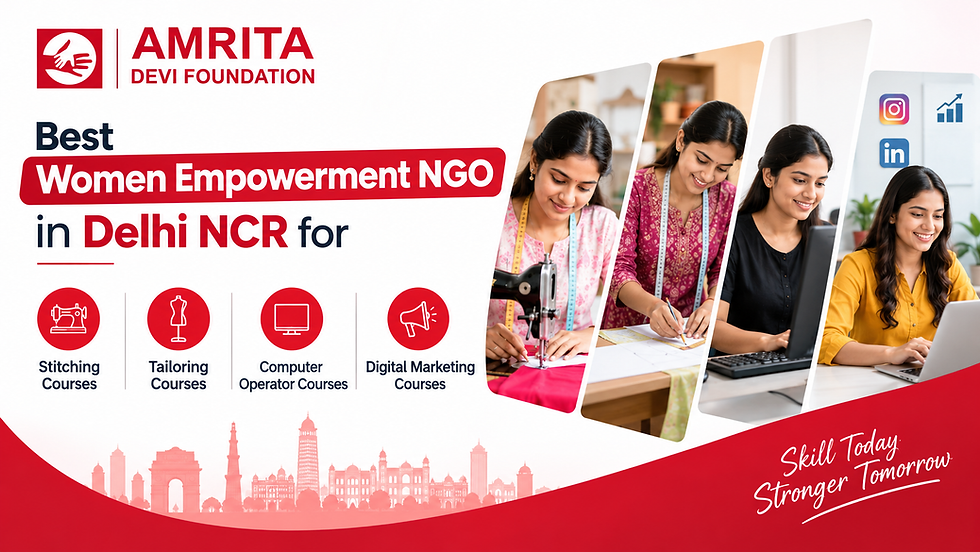
The Amrita Devi Women Skill Development Institute (ADWSDI) is a core initiative of Amrita Devi Foundation focused on helping women and girls become more self-reliant, confident and economically independent. Its stated vision includes reducing migration from hill regions while improving women's socio-economic opportunities through practical, job-oriented and entrepreneurship-focused training.
The institute focuses on areas including:
Stitching & Tailoring
Helping women develop practical vocational skills that can support employment and entrepreneurship.
Computer Operator Training
Building foundational digital and workplace capabilities.
Digital Marketing
Helping women explore opportunities connected to the growing digital economy.
The initiative aligns its work with SDG 4: Quality Education, SDG 5: Gender Equality and SDG 8: Decent Work and Economic Growth.
Why Benna’s Story Matters to a Woman in Gurgaon
Imagine a woman living in Gurgaon.
She has a smartphone.
She has a skill.
Maybe she knows stitching.
Maybe she makes jewellery.
Maybe she cooks exceptionally well.
Maybe she creates handmade products.
But she doesn't know how to reach customers online.
Her problem isn't necessarily a lack of talent.
It may be a skills-to-market gap.
Now imagine she learns:
WhatsApp Business + Digital Payments + Product Photography + Social Media + Basic Marketing
Her existing skill suddenly has a larger market.
That's the lesson Benna's story carries far beyond Uttarakhand.
Digital skills don't always replace traditional skills.
Sometimes, they help traditional skills reach new customers.
What HR Leaders Can Learn From This
For HR professionals, Benna's story also offers a lesson about employability.
A certificate is valuable.
But confidence, practical skills and the ability to apply knowledge are what make training useful.
Organizations can support women through:
Skill-based hiring
Return-to-work programs
Flexible work opportunities
Mentorship
Digital-skills training
Women-focused internships
Entrepreneurship support
The Economic Survey 2025–26 reports that India's female labour-force participation rate rose from 23.3% in 2017–18 to 41.7% in 2023–24, while also noting continuing structural barriers such as mobility and caregiving constraints.
So the question for employers shouldn't simply be:
"Are women skilled?"
It should also be:
"Are our workplaces accessible to skilled women?"
What CSR Leaders Can Do Differently
Benna's story can also inform CSR strategy.
Instead of funding training alone, companies can consider supporting the complete journey:
1. Access
Bring training closer to communities.
2. Skills
Provide relevant, practical training.
3. Digital Inclusion
Ensure women can use technology confidently.
4. Mentorship
Connect learners with professionals.
5. Market Linkages
Help women reach customers or employers.
6. Follow-Up
Track what happens after training.
7. Scale
Support successful models in additional communities.
This is how CSR can become a pathway to sustainable livelihoods, rather than simply a program with a completion date.
The Most Powerful Transformation Isn't From Smartphone to Business
It's from:
"I don't know how."
to
"I can learn."
Then:
"I can do it."
And finally:
"I can teach someone else."
That is the transformation Benna Devi represents.
Her smartphone was a tool.
Tailoring was a skill.
Training was the opportunity.
But confidence was the real change.
From One Woman to 18 More
Benna's story leaves us with a simple but powerful thought.
If one woman can move from never having used a smartphone to running a tailoring business online—and then train 18 other women—what happens when thousands of women receive similar opportunities?
The answer isn't simply more businesses.
It can mean:
More household income
More local entrepreneurship
More confidence
More digital participation
More women becoming role models
More knowledge circulating within communities
And ultimately:
More women deciding their own economic future.
Conclusion: Empowerment Begins With Opportunity
The story of Benna Devi isn't really about a smartphone.
It isn't even only about tailoring.
It is about what becomes possible when a woman receives the right opportunity at the right time.
From a first interaction with digital technology to an online tailoring business.
From learner to entrepreneur.
From entrepreneur to trainer.
From one woman to 18 more.
That's what meaningful women skill development in Uttarakhand can look like.
And it is a lesson that applies equally to communities in Uttarakhand, New Delhi, Gurgaon and across India:
Don't just give people tools. Help them learn how to turn those tools into opportunities.
Because the most powerful measure of skill development isn't how many people entered the classroom.
It's how many possibilities walked out of it.
Frequently Asked Questions
What is the role of a Women Skill Development Institute in Uttarakhand?
A women skill development institute can provide practical, employment-oriented and entrepreneurship-focused training that helps women build capabilities for livelihoods and greater economic independence. ADWSDI specifically states that its mission includes helping women become self-reliant and reducing migration pressures in hill regions.
Who is Benna Devi?
Benna Devi is presented by Amrita Devi Foundation as a 2024 graduate of its Amrita Devi Women Skill Development Institute in Manila, Uttarakhand. The Foundation says she progressed from never having used a smartphone to running a tailoring business online and training 18 women in her village.
How can digital skills help women entrepreneurs?
Digital skills can help women communicate with customers, promote products, access information, use digital payments and explore wider markets. Research from the World Bank links stronger digital use and skills with better employment-related outcomes, while noting that skills alone cannot remove every structural barrier.
Why is women entrepreneurship important in India?
Women-led enterprises can contribute to household incomes, employment and local economic activity. India's ASUSE 2025 data reported that female-owned proprietary establishments increased from 26.2% in 2023–24 to 27.0% in 2025.
How can companies support women skill development?
Companies can support women through CSR funding, digital-skills programs, vocational training, mentorship, market linkages, employment opportunities and long-term partnerships with credible implementation organizations.


Comments