

Rural Women Empowerment Through Skill Development: How Amrita Devi Foundation Helps Women Become Independent


Rural Women Are Not Short of Talent. They Are Short of Opportunity.
Imagine a woman living in a small village in Uttarakhand.
Every morning begins before sunrise.
She prepares food, takes care of the family, completes household responsibilities and, whenever possible, helps with farming or other work.
She has ideas.
She has talent.
She wants to earn.
She wants her children to see her as someone who can build something of her own.
But there is one problem.
Where does she start?
There may be no nearby training institute.There may be limited employment opportunities.Travelling to a city may not be practical.She may not know how to use a computer.She may not have the confidence to approach a customer or employer.And even when she has a skill, she may not know how to turn that skill into income.
This is why rural women empowerment is not simply about providing financial assistance. It is about creating access to skills, confidence, technology and opportunities.
That is where organizations working at the grassroots level can make a meaningful difference.
One such initiative is Amrita Devi Foundation, which works to create employment-oriented opportunities for women through its Amrita Devi Women Skill Development Institute (ADWSDI). Its programs include Stitching & Tailoring, Computer Operator and Digital Marketing, along with personality development support.
The Reality: Why Is It Difficult for Rural Women to Become Independent?
The phrase "women should become independent" sounds simple.
The journey is not.
For a rural woman, independence can mean many things:
Earning her own income
Contributing financially to her family
Starting a small business
Getting a job
Using digital technology confidently
Making financial decisions
Being recognized for her abilities
Building a professional identity
Becoming an example for other women
But several barriers can stand between her and these goals.
1. Limited Access to Job-Oriented Skills
A woman may be educated but still lack practical employment skills.
Knowing basic mathematics or completing school does not automatically mean knowing how to operate workplace software, manage customers, stitch garments professionally or promote a product online.
The Economic Survey 2025-26 reports that India's female labour force participation rate increased from 23.3% in 2017-18 to 41.7% in 2023-24, with rural women being a major driver of this increase. However, women continue to face structural barriers such as mobility constraints, caregiving responsibilities and inflexible work arrangements.
This tells us something important:
Participation is increasing, but access to the right opportunities still matters.
2. Mobility Can Become a Major Barrier
For many rural women, travelling several kilometres every day for employment or training isn't easy.
Family responsibilities, transportation, safety concerns and social expectations can all influence whether a woman is able to leave her village for work or education.
This is particularly important in geographically challenging regions such as the hill areas of Uttarakhand.
Instead of asking only:
"Why doesn't she go to the city and find a job?"
we should also ask:
"Why can't opportunity come closer to her?"
That shift in thinking is at the heart of grassroots skill development.
3. Digital Literacy Is Becoming an Economic Skill
A smartphone is no longer only a communication device.
For an entrepreneur, it can become a:
Marketing tool
Customer communication platform
Payment gateway
Learning device
Business research tool
Networking channel
The World Bank notes that digital technologies can expand women's access to education, information and economic opportunities while helping overcome mobility constraints. It also highlights the continuing digital gender divide.
This is why teaching a rural woman how to use technology productively can be as important as teaching her a traditional vocational skill.
4. Skills Alone Are Not Always Enough
There is another important truth.
Training does not automatically create independence.
A woman may learn tailoring but still need customers.
She may learn computer operations but still need employment opportunities.
She may learn digital marketing but still need practical experience, communication skills and a portfolio.
She may have a business idea but struggle to access finance.
The World Bank's research on rural women entrepreneurs highlights barriers including access to formal credit, marketing, technology, advisory support and business development services. Women-owned rural enterprises already provide employment to an estimated 22–27 million people, demonstrating the economic potential of women-led rural businesses.
Therefore, effective women empowerment should follow a larger journey:
Skill → Confidence → Application → Opportunity → Income → Independence
A Story That Shows What Is Possible: Benna Devi
Sometimes statistics explain the problem.
But stories explain the impact.
Consider Benna Devi from Manila, Uttarakhand.
Three years ago, according to Amrita Devi Foundation, Benna had never touched a smartphone.
Today, she runs a tailoring business online.
But her story doesn't end with her own income.
She has also trained 18 other women in her village. Benna is a 2024 graduate of the Amrita Devi Women Skill Development Institute.
Think about that transformation.
A woman who once had limited exposure to digital technology is now using it in connection with her livelihood.
And then she is passing that knowledge to other women.
This is what meaningful empowerment can look like.
One woman learns.One woman earns.One woman teaches.A community begins to change.
That is the multiplier effect of grassroots skill development.
How Amrita Devi Foundation Helps Rural Women Become Independent
For Amrita Devi Foundation, empowerment starts with access to practical, employment-oriented skills.
Through ADWSDI, the Foundation provides training in three key areas:
1. Stitching & Tailoring
2. Computer Operator
3. Digital Marketing
The Foundation describes these programs as focused on helping women become self-reliant, confident and economically independent. It operates skill development centres in rural areas of Uttarakhand, including districts such as Almora, Bageshwar and Pithoragarh.
1. Stitching & Tailoring: Turning a Skill Into a Livelihood
For many rural women, tailoring can offer something extremely valuable:
the possibility of earning closer to home.
A trained woman can potentially work from home, provide alteration services, stitch garments for local customers, work with boutiques or gradually develop her own tailoring business.
But the real impact goes beyond learning how to operate a sewing machine.
It is about building the confidence to say:
"I can create something that people are willing to pay for."
ADF's Stitching & Tailoring program focuses on practical skills such as cutting, stitching, embroidery and garment tailoring, with the broader aim of enabling home-based businesses and employment opportunities. Personality development is also incorporated to strengthen confidence and customer interaction.
And this creates an interesting possibility.
A woman who starts by stitching clothes for neighbours may eventually become:
a tailor → a business owner → an employer → a trainer.
Benna Devi's story demonstrates how that journey can extend into digital business and training other women.
2. Computer Operator Training: Opening the Door to the Digital Workplace
Imagine a woman who has never worked on a computer.
At first, opening a software application may feel complicated.
Then she learns.
She learns how to manage files.
She learns basic office applications.
She learns spreadsheets.
She learns how digital systems work.
And slowly, the computer stops being something intimidating.
It becomes a tool.
ADF's Computer Operator program focuses on computer literacy and workplace-oriented capabilities, including essential computer applications. The program also includes personality development sessions covering communication, confidence and workplace etiquette.
This matters because digital literacy can connect rural women to opportunities that may not have existed for them before.
It can support pathways toward roles involving:
Data entry
Office assistance
Documentation
Digital administration
Online applications
Basic business operations
The goal isn't simply:
"Teach her computers."
The goal is:
"Give her another tool through which she can participate in the economy."
3. Digital Marketing: Taking Rural Talent to the Internet
This is where the traditional idea of rural employment starts to change.
A woman doesn't necessarily need to move to Delhi, Dehradun or another major city to explore digital opportunities.
With the right skills and access to technology, she may be able to work with clients, businesses or customers beyond her immediate community.
Digital marketing training can introduce women to areas such as:
Social media management
Content creation
Basic graphic design
SEO
Online promotion
Freelancing concepts
Digital entrepreneurship
ADF's Digital Marketing Course is designed as an online, industry-relevant program and includes personality development, internship opportunities and connections to employment opportunities through its network.
And Benna Devi's story provides a powerful example of how digital knowledge can complement a traditional livelihood.
She didn't have to choose between tailoring and technology.
She used technology to strengthen her tailoring business.
That is the future of rural women empowerment:
Traditional skills + modern technology.
Free Skill Development Can Remove One of the Biggest Barriers: Cost
For many women, the desire to learn exists.
The money to pay for training may not.
ADF states that its women-focused skill development courses are provided free to women and girls from underserved communities.
This matters because the first barrier to independence should not be:
"Can I afford to learn?"
Instead, the focus should be:
"What can I build after I learn?"
Removing or reducing the cost of training can make it easier for women from economically underserved communities to access employment-oriented education.
The Educational Truth: Empowerment Is More Than Earning Money
Financial independence is important.
But it is only one part of empowerment.
When a woman develops skills and starts using them, several changes can happen.
Confidence increases
She begins to trust her own abilities.
Decision-making can improve
Income and financial knowledge can give women greater participation in household decisions.
Social recognition can grow
A woman known only as someone's daughter, wife or mother can increasingly be recognized for her own professional identity.
Children see a different future
When children see their mother learning, working or running a business, their understanding of what is possible can change.
Knowledge spreads
A trained woman can teach another woman.
This is exactly why Benna Devi's story is so powerful: her journey did not stop with her own business. She reportedly went on to train 18 other women in her village.
From Skill to Identity: The Real Meaning of Independence
There is a difference between having a skill and having an identity built around that skill.
A woman who knows stitching has a skill.
A woman who uses that skill to serve customers has a livelihood.
A woman who builds a tailoring business has an enterprise.
A woman who trains other women becomes a community resource.
And a woman who is recognized for her work begins to build an identity beyond traditional social roles.
That is why rural women empowerment should not be measured only by:
"How many women completed the course?"
We should also ask:
How many started earning?
How many became self-employed?
How many found jobs?
How many started businesses?
How many trained others?
How many became more confident?
How many created opportunities for other women?
The real outcome is not the certificate.The real outcome is what the woman does with the skill.
ADF's Approach: Skill → Confidence → Opportunity
ADF's women skill development model brings together three important dimensions.
Practical Skills
Stitching, tailoring, computer operations and digital marketing.
Personality Development
Communication, confidence and workplace readiness.
Opportunity Orientation
Employment, entrepreneurship, internships and pathways toward self-reliance.
The Foundation says its ADWSDI initiative aligns with SDG 4: Quality Education, SDG 5: Gender Equality and SDG 8: Decent Work and Economic Growth.
This approach recognizes a simple truth:
A certificate alone cannot change a life.Skills that can be applied can.
Rural Women Empowerment Is Also Rural Community Development
When a woman becomes economically active, the impact can extend beyond her.
Consider a simple example.
A woman learns tailoring.
She starts taking orders.
Her income increases.
She buys better equipment.
Her daughter sees her mother running a business.
Another woman asks her to teach tailoring.
She trains her.
The second woman begins earning.
Now two households have gained an opportunity.
This is why investing in women can create a ripple effect.
The World Bank's research similarly points to women-owned rural enterprises as an important source of employment and rural economic growth.
What Rural Women Need Next
Skill development is a powerful starting point, but the ecosystem around women also matters.
A stronger model of rural women empowerment should connect:
Training + Digital Access + Finance + Mentorship + Markets + Employment + Community Support
This is especially important for women who want to move from self-employment into entrepreneurship.
Research by the World Bank has found that access to formal credit is an important enabler of growth for women entrepreneurs, while many rural women continue to rely heavily on household savings and self-help groups.
So the next chapter of women empowerment should not simply be:
"Teach women a skill."
It should be:
"Teach the skill, create the confidence, connect the opportunity and help the woman use it."
Why CSR Partnerships Can Accelerate Rural Women Empowerment
For companies, supporting women skill development is more than a CSR activity.
It can become an investment in:
Employability
Rural entrepreneurship
Digital inclusion
Gender equality
Community development
Sustainable livelihoods
Local economic participation
CSR partnerships can help organizations support training infrastructure, learning resources, community outreach, digital education and employment-oriented programs.
For NGOs like Amrita Devi Foundation, corporate partnerships can help take these opportunities to more women in underserved communities.
One CSR partnership can help create more than a training batch.
It can help create:
A skilled woman.A livelihood.A confident family.A stronger community.
The Bigger Dream: A Rural India Where Women Don't Have to Leave Home to Find Opportunity
For Uttarakhand, this vision has another important dimension.
ADF says one of its objectives is to address migration from the hill regions by creating better skill development and employment opportunities for women within the state.
The idea is not to tell every woman that she must stay in her village.
It is about giving her a choice.
If she wants to move, she should be free to move.
If she wants to build a livelihood in her village, she should have the skills and opportunities to do that too.
Migration should be a choice, not the only path to opportunity.
From One Woman to Many: The Future of Rural Women Empowerment
The most powerful question is not:
"How many women can we train?"
It is:
"How many women can become independent because of the woman we trained?"
Benna Devi gives us one answer.
She learned.
She built a tailoring business.
She embraced digital tools.
And she trained 18 other women.
Her story shows why skill development can create a multiplier effect.
This is the kind of change that begins quietly.
One sewing machine.
One computer.
One smartphone.
One classroom.
One woman who decides:
"I can do this."
And sometimes, that one decision can change much more than one life.
How You Can Support Rural Women Empowerment
If you are a CSR leader, company, HR professional, donor or individual, you can contribute to creating more opportunities for women by:
Supporting free skill development programs
Sponsoring training centres
Supporting digital literacy
Creating employment opportunities
Connecting women entrepreneurs with markets
Providing mentorship
Supporting women-led businesses
Volunteering your professional expertise
Partnering with grassroots NGOs
ADF's support model is built around expanding skill development opportunities for underserved women and girls. Its Support Us page also invites individuals and organizations to contribute toward its women-focused programs.
Frequently Asked Questions
1. What is rural women empowerment?
Rural women empowerment means creating opportunities for women in rural communities to gain skills, access employment or entrepreneurship, participate in economic decisions and become more confident and self-reliant.
2. Why is skill development important for rural women?
Skill development can give women practical abilities that can be converted into employment, self-employment or entrepreneurship. It can also improve confidence and digital readiness.
3. What skills can help rural women become financially independent?
Depending on local opportunities and individual interests, useful skills can include tailoring, computer operations, digital marketing, handicrafts, food processing, entrepreneurship and other vocational or digital skills.
4. Does Amrita Devi Foundation provide free skill development courses for women?
Yes. Amrita Devi Foundation states that it provides free women-focused skill development programs through its Amrita Devi Women Skill Development Institute, including Stitching & Tailoring, Computer Operator and Digital Marketing.
5. Where does Amrita Devi Foundation work with rural women?
ADF's women skill development centres include rural areas of Uttarakhand, particularly districts such as Almora, Bageshwar and Pithoragarh, alongside online learning opportunities.
6. Can tailoring help a rural woman start a business?
Yes. Tailoring can provide a pathway toward home-based services, custom clothing, alterations, boutique work and other forms of self-employment. However, success also depends on factors such as customers, pricing, quality, equipment and business management.
7. Why is digital marketing useful for rural women?
Digital marketing can help women promote products and services online, communicate with customers and explore digital employment or entrepreneurship opportunities. Digital access and skills can also help overcome some mobility barriers.
8. How can companies support rural women through CSR?
Companies can support training infrastructure, sponsor women-focused skill development, provide digital resources, create employment linkages, offer mentorship and help women entrepreneurs access markets.
Conclusion: When a Woman Becomes Independent, Her Story Becomes Bigger Than Herself
Rural women do not need sympathy.
They need opportunity.
They need access to skills.
They need technology.
They need confidence.
They need markets.
They need employment opportunities.
And sometimes, they simply need someone to believe that their potential is worth investing in.
Amrita Devi Foundation's women skill development work is built around that belief — providing employment-oriented training in Stitching & Tailoring, Computer Operator and Digital Marketing to help women become more self-reliant and economically independent.
Because the ultimate goal is not to create women who have certificates.
It is to create women who can say:
"I can earn."
"I can decide."
"I can build."
"I can teach another woman."
And finally:
"I have my own identity."
Support the Movement
If you are a CSR leader, organization, donor, volunteer or individual who believes in creating sustainable opportunities for rural women, partner with Amrita Devi Foundation to help more women access employment-oriented skills and build independent futures.
Empower one woman. Strengthen one family. Transform one community.
SEO Implementation Checklist
Recommended H1:Rural Women Empowerment Through Skill Development: How Amrita Devi Foundation Helps Women Become Independent
Primary keyword:rural women empowerment
Supporting keywords:
women empowerment in rural India
skill development for rural women
rural women entrepreneurship
women self employment
women skill development NGO
free skill development courses for women
women empowerment NGO India
rural women financial independence
women skill development Uttarakhand
tailoring courses for rural women
computer training for women
digital marketing for rural women
Suggested internal links:
Amrita Devi Women Skill Development Institute → ADWSDI page
Stitching & Tailoring / Computer Operator / Digital Marketing → ADF Projects
Benna Devi's Story → Read Benna Devi's story
About ADF → About Amrita Devi Foundation
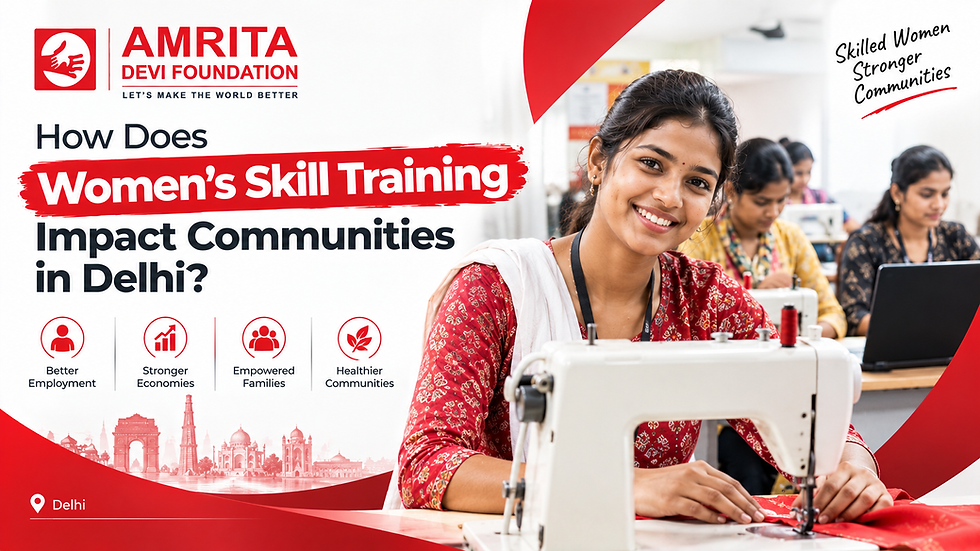
Suggested image ALT text:Rural women learning stitching computer and digital marketing skills through Amrita Devi Foundation
Suggested SEO thumbnail text:
FROM SKILL TO INDEPENDENCE
How Rural Women Are Building Their Own Future
Schema recommendations: Article + FAQPage + Organization + BreadcrumbList
This structure deliberately combines search intent + storytelling + educational facts + a real ADF impact story + CSR relevance + FAQ/voice-search queries, giving the article stronger topical depth rather than simply repeating the keyword "women empowerment."


Comments