

What CEOs Get Wrong About Social Impact: 4 CSR Mistakes That Cost More Than Money


A CSR presentation can look impressive.
Beautiful photographs.A large number of beneficiaries.A successful event.A plantation drive.A training certificate distribution ceremony.
The annual report looks complete.
But there is one uncomfortable question that every CEO, CHRO and CSR leader should ask:
Did we actually solve a problem—or did we simply complete a CSR activity?
This is where the difference between CSR activity and social impact becomes important.
A company can spend money responsibly and still create limited long-term change.
It can conduct a one-day workshop without changing someone's livelihood. It can distribute resources without understanding what the community actually needs. It can launch a campaign without building continuity.
And sometimes, the biggest CSR mistake isn't doing too little.
It is doing something without asking whether it is the right thing to do.
That is the central idea behind Amrita Devi Foundation's latest thought-leadership message:
"What CEOs Get Wrong About Social Impact."
The poster highlights four recurring problems:
Misaligned goals
Treating CSR as marketing
Ignoring real community needs
Lack of long-term commitment
For CEOs, CHROs and CSR decision-makers, these aren't merely social-sector concerns.
They are strategy concerns.
The New CSR Question: Are We Creating Impact or Just Reporting Activity?
CSR in India has evolved significantly.
For companies covered by Section 135 of the Companies Act, CSR is not simply an optional branding exercise. Companies are required to follow the applicable CSR framework, including eligible activities, governance, reporting and implementation requirements.
The Ministry of Corporate Affairs also emphasizes the importance of assessing social impact. Its CSR FAQ explains that impact assessment is intended to help companies make more considered decisions about CSR spending and improve the impact of their programs.
This leads to an important distinction:
Activity:"We trained 100 women."
Impact:"Women acquired relevant skills, and a measurable proportion progressed toward employment, self-employment or increased income."
The first is a number.
The second tells a story.
Mistake No. 1: Misaligned CSR Goals
Imagine a company decides:
"We want to run a women's skill-development program."
It sounds positive.
But before deciding the course, location, duration or beneficiary count, there should be another question:
What do women in that community actually need?
Maybe they need computer skills.
Maybe they need digital marketing.
Maybe they already know tailoring but need market access.
Maybe transportation is a barrier.
Maybe childcare prevents regular attendance.
Maybe the local employment market requires a different skill altogether.
A CSR program becomes stronger when the solution begins with the problem, rather than the company's preferred activity.
The strategic shift
Instead of:
"What CSR project should we run?"
Ask:
"What measurable problem can we realistically help solve?"
That single change can transform the entire CSR strategy.
The Community Should Not Be the Last Person Consulted
One of the biggest differences between traditional CSR and community-led social impact is who participates in defining the solution.
A top-down approach often looks like this:
Company → Project → NGO → Community
A stronger approach looks more like:
Community → Need Assessment → NGO Expertise → Company Resources → Measurable Solution
The second model creates room for local knowledge.
Because communities are not simply "beneficiaries."
They are often the people who understand the problem best.
Mistake No. 2: Treating CSR as Marketing
Let's be clear:
CSR communication matters.
Companies should communicate their impact.
Employees should know what their organization is contributing to society. Stakeholders deserve transparency. Investors and customers increasingly want to understand how companies create value beyond financial performance.
But communication should be the reflection of impact—not the substitute for it.
A CSR program shouldn't begin with:
"How will this look on LinkedIn?"
It should begin with:
"Will this still matter to the community six months from now?"
If the answer is no, the program needs another look.
The "Photo Opportunity" Trap
Consider two hypothetical CSR programs.
Program A
A company organizes a one-day educational event.
300 people attend.
There are photographs, banners, certificates and social media posts.
The campaign receives excellent engagement.
Program B
Another company supports a six-month skill-development program.
The organization conducts need assessment, provides training, tracks attendance, assesses learning, supports career readiness and follows up with participants.
Program B may produce fewer photographs.
But it may produce substantially deeper impact.
Visibility is not the same as impact.
The strongest CSR communication should make the impact visible—not manufacture the appearance of impact.
Mistake No. 3: Ignoring Real Community Needs
This is perhaps the most important mistake.
Sometimes organizations fall in love with their solution before understanding the problem.
They decide:
"We will distribute this."
"We will conduct that."
"We will organize a workshop."
But social problems rarely fit neatly into a one-day event.
Take women's employment as an example.
India has made progress, but significant gender gaps remain. World Bank data based on ILO modelled estimates puts India's female labour-force participation rate at around 32.4% in 2025, compared with 77.6% for men among the 15+ population measure used in that dataset.
The World Bank's 2026 India gender brief also notes that female labour-force participation increased from 22.9% in 2018 to 35.3% in 2025 using its cited measure, and highlights the economic significance of increasing women's participation.
These numbers tell us something important:
Skill development alone isn't enough.
Women may need:
Relevant skills
Digital literacy
Career guidance
Confidence
Access to employment
Entrepreneurship support
Market connections
Mentorship
Supportive workplaces
So the CSR question becomes:
Can we design a program around the complete journey rather than one isolated intervention?
A Story of Two CSR Programs
Consider this fictional example.
Two companies, both with strong CSR teams, decide to support women in a semi-urban community.
Company A
It conducts a three-day training workshop.
100 women attend.
The company reports:
"100 women empowered."
The project is completed.
Company B
It starts differently.
First, the implementing organization talks to women in the community.
The team identifies employment-oriented skills that are relevant locally.
Training is then provided.
Participants receive practical assignments.
Their progress is tracked.
Career-readiness sessions are added.
Potential employers are approached.
Follow-up happens after the training.
Company B may not be able to say:
"We solved women's unemployment."
But it can begin answering better questions:
How many women completed training?
What did they learn?
How many demonstrated competency?
How many moved toward employment?
How many started earning?
What barriers remained?
What should the next phase change?
That is what impact thinking looks like.
Mistake No. 4: No Long-Term Commitment
Social change rarely works like a quarterly sales target.
A community does not transform because a project has a six-month deadline.
A woman doesn't necessarily become financially independent because she completed one course.
A plantation doesn't become an ecosystem because a tree was planted.
A young person doesn't become employable because they attended one seminar.
Impact needs continuity.
This doesn't necessarily mean every CSR project must run for ten years.
It means companies should think beyond:
Launch → Event → Report → Finish
and consider:
Assess → Design → Implement → Measure → Learn → Improve → Scale
That is a very different mindset.
What CEOs Should Ask Before Approving a CSR Project
Before signing off on a CSR initiative, leadership teams can ask seven questions.
1. What problem are we solving?
If the team cannot explain the problem in one clear paragraph, the project may not be ready.
2. Who defined the problem?
Was it identified by the company, or did the community participate?
3. Why this intervention?
Why training? Why healthcare? Why education? Why environmental work?
The answer should be evidence-based.
4. What does success look like?
Define measurable outcomes before implementation.
5. What happens after the funding period?
A project should have a realistic sustainability plan.
6. How will we measure impact?
Numbers such as beneficiaries reached are useful—but outcome indicators are often more meaningful.
7. What did we learn?
The best CSR programs don't simply report success.
They learn from failure too.
From CSR Spending to Social Investment
This is the mindset shift CEOs need.
CSR spending asks:
"Where did the money go?"
Social investment asks:
"What changed because the money went there?"
The first is financial accountability.
The second combines financial accountability with social outcomes.
Both matter.
What Does Strategic CSR Look Like?
A strategic CSR program connects five things:
1. Business Capability
What can the company contribute beyond money?
Technology? Expertise? Employees? Infrastructure? Market access?
2. Community Need
What does the community actually need?
3. NGO Expertise
Which organization has the local knowledge and implementation capability?
4. Measurable Outcomes
What should change because of the program?
5. Long-Term Sustainability
How can the intervention continue creating value?
This is where NGO–corporate partnerships become powerful.
Why NGOs Can Be Strategic CSR Partners
A company may have capital, technology and professional expertise.
An NGO may have something equally valuable:
community trust.
A capable NGO can help companies:
Understand local communities
Identify beneficiaries
Design interventions
Implement programs
Monitor progress
Build grassroots relationships
Create feedback loops
Indian CSR rules explicitly recognize eligible implementing entities, including qualifying Section 8 companies and certain registered public trusts and societies, subject to the applicable requirements. CSR implementing entities also have registration requirements such as CSR-1 under the relevant rules.
The point is not simply to "find an NGO."
It is to find the right implementation partner for the problem.
Where Amrita Devi Foundation Fits Into This Conversation
At Amrita Devi Foundation, social impact is approached through initiatives spanning women's skill development, environmental sustainability and youth skill development.
The Foundation's work creates potential areas for CSR partnerships around:
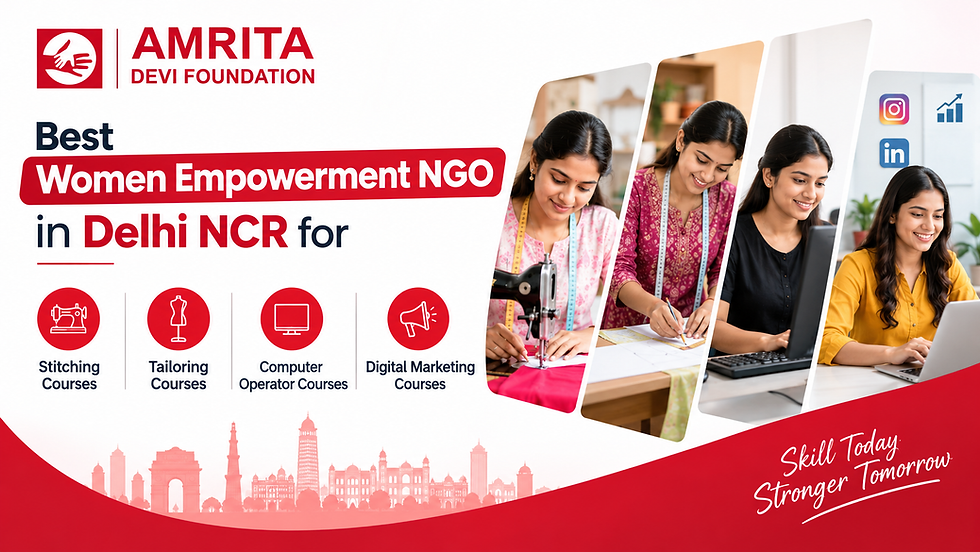
Women's Empowerment
Through practical skill-development initiatives such as:
Stitching & Tailoring
Computer Operator training
Digital Marketing
The objective is to create pathways toward skills, livelihoods and greater economic independence.
Environmental Sustainability
Through initiatives such as:
Plantation
Afforestation
Environmental awareness
Smokeless Chulha distribution
Community cleanliness activities
Youth Skill Development
Through initiatives focused on:
AI literacy
Digital skills
Financial literacy
Digital marketing
Employability
This creates an opportunity for companies to move from one-time CSR activities to structured social-impact programs.
The CEO's Role Is Bigger Than Signing the CSR Budget
CSR is sometimes delegated entirely to a CSR department.
But social impact becomes stronger when leadership is involved.
The CEO can ask:
What problem are we trying to solve?
The CHRO can ask:
How can our employees contribute their skills?
The CSR head can ask:
How do we implement and measure it?
The CFO can ask:
Are the resources being used responsibly?
The communications team can ask:
How do we tell the story without exaggerating it?
And the community can ask:
Does this actually help us?
When all five perspectives come together, CSR becomes more than a budget line.
It becomes an organizational commitment.
HR Heads and CHROs: CSR Can Also Strengthen Employee Engagement
There is another opportunity that companies sometimes overlook.
Employees want to participate in meaningful work.
A CSR partnership can become an employee-engagement platform through:
Skill-based volunteering
Mentorship
Career guidance
Environmental volunteering
Employee fundraising
Community visits
Knowledge-sharing sessions
Imagine a company's digital marketing team mentoring women learning digital marketing.
Or its HR team conducting mock interviews.
Or its finance professionals teaching financial literacy.
Or employees participating in a plantation initiative.
The company isn't only donating money.
It is contributing capability.
CSR Should Not Be About Doing More
This is perhaps the strongest message from the poster:
It's not about doing more. It's about doing it right.
Companies don't necessarily need ten new CSR projects.
They may need one better-designed project.
One community.
One clearly defined problem.
One capable implementation partner.
One measurable objective.
One long-term commitment.
That can create more value than a dozen disconnected activities.
The Future of CSR: From Beneficiaries to Partners
The language we use matters.
Instead of calling people merely beneficiaries, consider them participants, learners, entrepreneurs, community members and partners in change.
That shift reflects a deeper philosophy.
People are not empty spaces waiting for corporations to fill them with solutions.
They already have:
Knowledge
Skills
Aspirations
Experience
Ideas
Agency
The role of CSR should often be to unlock what already exists and add the resources required to move it forward.
A Practical CSR Framework for CEOs
Here's a simple framework leadership teams can use:
LISTEN
Understand the community.
↓
ALIGN
Connect the need with the company's CSR priorities.
↓
PARTNER
Choose an NGO or implementation partner with relevant capability.
↓
ACT
Implement a practical, measurable intervention.
↓
MEASURE
Track outputs, outcomes and where appropriate, longer-term impact.
↓
LEARN
Understand what worked and what didn't.
↓
SCALE
Expand only when evidence suggests the model is effective.
This is how CSR can evolve from activity management to impact management.
The Real Question CEOs Should Be Asking
The question isn't:
"How much CSR did we do this year?"
It is:
"What changed because we were there?"
Did a woman gain a skill?
Did that skill lead to an opportunity?
Did a young person become more employable?
Did a community become more resilient?
Did a plantation initiative improve environmental stewardship?
Did employees become more socially engaged?
Did the program continue after the first funding cycle?
These are harder questions.
But they are the questions that matter.
Conclusion: Real Impact. Real Change.
CSR is no longer simply about writing cheques, organizing events or publishing photographs.
The expectations are higher.
Communities expect relevance.
Employees expect authenticity.
Leadership expects measurable outcomes.
And society increasingly expects businesses to be responsible participants in development.
The companies that will stand out won't necessarily be the ones that spend the most.
They will be the ones that listen better, partner smarter, measure honestly and stay committed longer.
That is the difference between CSR as an activity and CSR as social impact.
At Amrita Devi Foundation, we believe meaningful change is built through the right combination of community needs, practical action, capable partnerships and long-term commitment.
So, before your organization launches its next CSR initiative, ask one simple question:
Are we doing more—or are we doing it right?
Because real impact isn't about creating a bigger report.
It's about creating a better reality.
For CEOs, CHROs, HR & CSR Leaders
If your organization is looking to build meaningful, measurable and community-focused CSR initiatives, Amrita Devi Foundation can explore partnership opportunities across:
Women Empowerment | Skill Development | Youth Development | Environmental Sustainability | Community Development
Let's build impact that lasts.
SEO Keyword Cluster
Primary keyword:social impact strategy
Secondary keywords:CSR strategy in India · corporate social responsibility · CSR partnerships with NGOs · social impact programs in India · CSR NGO partnership · strategic CSR · CSR impact assessment · community-led development
Long-tail keywords:
What CEOs get wrong about social impact
How to create an effective CSR strategy in India
How companies can create measurable social impact
How to choose an NGO for CSR partnership
Best NGO partnerships for corporate social responsibility
How CEOs can improve CSR impact
How CHROs can support social impact through CSR


Comments