

Women’s Challenges Around the World: How Amrita Devi Foundation Is Turning Barriers into Opportunities


A woman may have the talent to become an entrepreneur but lack the resources to start a business. Another may want to work but have never received professional training. A young woman may have access to a smartphone yet lack the digital skills required to find employment.
These challenges are not limited to one city or one country. Across the world, women continue to face barriers to education, employment, financial independence, technology and equal opportunities.
Women’s empowerment is not simply about giving women support. It is about removing barriers that prevent them from using their potential.
This is where skill development, digital education and employment-oriented training can make a difference. Through its initiatives, Amrita Devi Foundation works to help women and young people develop practical skills and build pathways towards greater independence.
1. Financial Dependence and Limited Employment Opportunities
One of the biggest challenges women face worldwide is unequal access to paid work, fair wages and economic independence.
The International Labour Organization reported that in 2024, only 46.4% of working-age women were employed, compared with 69.5% of men globally. Women also remain underrepresented in management and overrepresented in lower-paid work.
For women in underserved communities, the barriers can be even more practical: limited access to training centres, lack of professional experience, restricted mobility, household responsibilities and few local employment opportunities.
How Amrita Devi Foundation helps
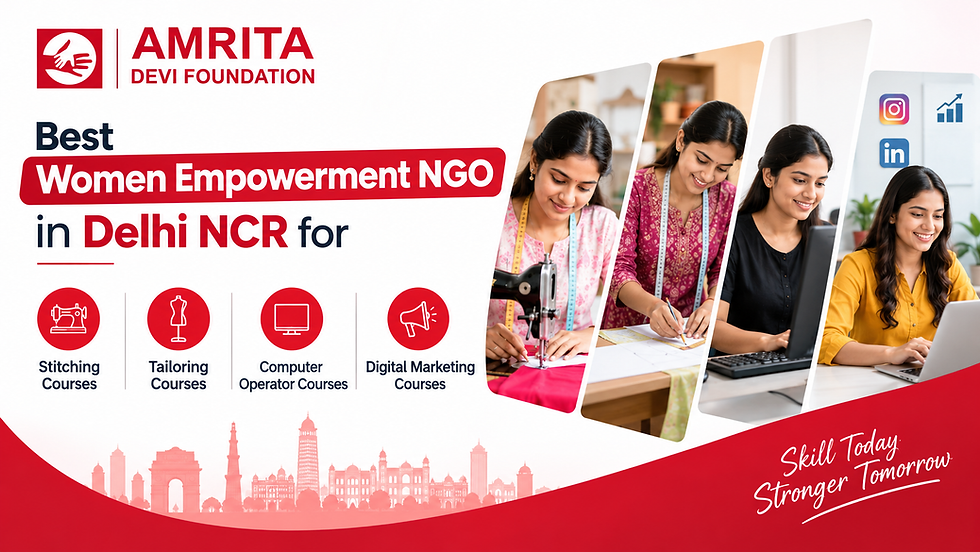
Through the Amrita Devi Women Skill Development Institute (ADWSDI), ADF provides employment-oriented training in:
Stitching and Tailoring: Skills that can support home-based work, tailoring services and entrepreneurship.
Computer Operator: Practical computer skills, office applications and data entry.
Digital Marketing: Skills relevant to social media, content, online promotion and the digital economy.
The goal is to help women develop capabilities they can use to explore employment and self-employment opportunities.
2. The Digital Divide: Women Risk Being Left Behind
Access to technology does not automatically mean access to digital opportunity.
A woman may own a smartphone but lack the knowledge to create a professional document, apply for a job online, manage a business account or promote her products digitally.
The consequences can extend beyond employment. Limited digital skills can also restrict access to online learning, financial services and information.
UN Women and the UN Department of Economic and Social Affairs highlighted the economic importance of closing the gender digital divide in their 2025 Gender Snapshot. Their analysis estimated that closing this divide could generate an additional $1.5 trillion in global GDP by 2030.
UN Women Transparency Portal
How Amrita Devi Foundation helps
ADF's Computer Operator and Digital Marketing programmes help learners build practical digital capabilities.
The Computer Operator programme develops foundational workplace skills, while Digital Marketing introduces learners to opportunities in online business promotion and digital communication.
For women who have had limited exposure to technology, learning these skills can be an important first step towards participating more confidently in the digital economy.
3. Unpaid Care Work and Limited Time for Learning
Women around the world continue to shoulder a disproportionate share of unpaid household and care responsibilities.
The World Bank's Women, Business and the Law 2024 report found that women spend an average of 2.4 more hours per day on unpaid care work than men.
Cooking, childcare, caring for older family members and managing household responsibilities can make it difficult to attend training or accept work that requires long commutes.
This is particularly important for women in rural communities, where professional training opportunities may be far from home.
How Amrita Devi Foundation helps
ADF established women skill-development centres in rural areas of Uttarakhand, including communities in the Almora, Bageshwar and Pithoragarh regions. Its stated mission includes expanding access to skills and employment opportunities so women can build livelihoods without necessarily having to migrate to cities.
By bringing training closer to underserved communities and providing online learning opportunities for relevant programmes, ADF aims to reduce some of the barriers women face in accessing education.
Training alone cannot remove every care-related or mobility challenge, but improving access is a meaningful part of the solution.
4. Lack of Confidence, Professional Exposure and Business Skills
Sometimes, the challenge is not a lack of talent. It is a lack of opportunity to practise that talent professionally.
A woman may know how to stitch clothes but not how to price her work, find customers or manage orders.
Another may use social media every day but not know how to turn those skills into a professional service.
A young woman may understand basic computer operations but feel nervous about interviews or workplace communication.
Skills become more valuable when learners can apply them in real situations.
How Amrita Devi Foundation helps
ADF combines technical training with personality development and workplace-oriented learning. Its programmes aim to strengthen practical abilities, communication, confidence and readiness for employment or entrepreneurship.
The Foundation's approach connects three important elements:
Practical skills → Confidence → Opportunity
While training cannot guarantee a job or business success, it can give women a stronger foundation from which to pursue their goals.
5. Limited Access to Opportunities in Rural Communities
Women in remote areas may face additional challenges: fewer nearby training centres, limited exposure to employers, restricted access to professional networks and pressure to migrate in search of work.
These barriers can affect not only women but also their families and communities.
ADF's work focuses on developing local capabilities and creating pathways towards livelihoods in underserved areas.
One example is Benna Devi from Manila, Uttarakhand, whose story is featured on ADF's official website. According to the Foundation, she progressed from having never used a smartphone to running an online tailoring business and training 18 other women in her village.
Empowering Women & Sustainability
Her story illustrates how a practical skill can potentially create opportunities beyond one individual.
It is not a guarantee that every learner will achieve the same outcome. It is an example of what can become possible when training, initiative and opportunity come together.
Amrita Devi Foundation: Impact in Numbers
ADF's work connects women's skill development with youth empowerment and environmental sustainability.
1,800+
Students trained
400+
Supported towards self-employment
300+
Students currently in training
3
Core women’s training areas
Figures reported on ADF's official Support Us page; see the Foundation's impact and support information.
The three core training areas are Stitching & Tailoring, Computer Operator and Digital Marketing. ADF's broader work also includes environmental initiatives through Amrita Devi Earth Care and youth employability programmes through Amrita Devi Skill India.
Why Women's Empowerment Also Matters for Businesses and CSR Leaders
Women’s empowerment is not only a social objective. It is also connected to economic participation, stronger communities and inclusive development.
Companies can help expand access to opportunities through CSR partnerships that support:
Vocational and digital-skills training.
Computers, equipment and learning infrastructure.
Mentorship from industry professionals.
Internship and employment connections.
Women's entrepreneurship initiatives.
Skill-development centres in underserved communities.
For meaningful impact, organisations should look beyond the number of people enrolled. Useful measures include course completion, skills gained, employment or self-employment outcomes, and the progress of learners over time.
ADF welcomes support for initiatives that connect skill development, women's empowerment and sustainable community development. Companies considering CSR partnerships should verify the Foundation's current eligibility and applicable compliance documentation before committing funds.
Conclusion: Empowerment Begins When Barriers Start to Fall
The challenges women face around the world are complex. Skill training alone cannot eliminate discrimination, unequal care responsibilities, unsafe environments or every barrier to employment.
But practical education can help address one essential part of the problem: the gap between a woman's potential and her access to opportunity.
Through the Amrita Devi Women Skill Development Institute, Amrita Devi Foundation works to make vocational and digital skills more accessible to women. Through its wider initiatives, it also supports youth development and environmental sustainability.
The vision is straightforward: help more women gain the skills, confidence and capabilities to pursue greater independence.
Because a woman should not have to choose between having potential and having opportunity.
She deserves the chance to learn, build, earn and lead.
Support Women's Empowerment with Amrita Devi Foundation
Individuals, volunteers and companies can explore ways to support skill-development programmes, mentorship and community initiatives.
Visit Amrita Devi Foundation to learn about its programmes and support its initiatives.
Frequently Asked Questions
What are the biggest problems women face around the world?
Common challenges include unequal access to employment, wage disparities, unpaid care work, digital exclusion, barriers to education, discrimination and limited access to finance and leadership opportunities.
How does skill development help women become independent?
Skill development can improve practical capabilities and help women pursue employment, self-employment or entrepreneurship. Outcomes depend on access to opportunities, individual circumstances and continued support.
How does Amrita Devi Foundation support women?
ADF provides training in Stitching & Tailoring, Computer Operator and Digital Marketing through its Women Skill Development Institute. It also works on youth empowerment and environmental sustainability.
Can companies support women's empowerment through CSR?
Companies can explore eligible CSR projects involving vocational training, digital literacy, equipment, mentorship and employment pathways. They should verify the implementing organisation's current eligibility and compliance before partnering.
What makes women's empowerment sustainable?
Sustainable empowerment combines practical skills with continued learning, access to markets and employers, mentorship, financial opportunities and the ability to make informed decisions.


Comments